What Should a Paving Contractor Analyze Before Entering a New Local Service Market?

Expanding into a new local service market can create a major growth opportunity for a paving contractor. A nearby city or neighborhood may appear to have plenty of roads, driveways, parking lots, and commercial properties that need paving work. But visible demand does not automatically mean the market is profitable or easy to enter.
Before expanding, a paving contractor needs to understand more than how many potential customers live in an area. The contractor should examine search demand, competitors, service needs, pricing, project types, travel costs, reputation, and the strength of the company's online presence.
This is where careful market analysis becomes important. Instead of entering a new area simply because it looks busy, contractors can use real market signals to determine whether the opportunity fits their business.
1. Start With Actual Service Demand
The first question is simple: Are enough people looking for paving services in the new area?
A market may have thousands of homeowners and businesses but still produce limited paving opportunities. Population alone does not tell you whether customers are actively searching for the services you provide.
Look at the types of projects that are common in the area, such as:
-
Residential driveway paving
-
Asphalt replacement
-
Parking lot paving
-
Commercial paving
-
Asphalt repair
-
Sealcoating
-
Crack repair
-
Resurfacing
-
New asphalt installation
The demand may also vary depending on the property's age, local development, weather conditions, and construction activity.
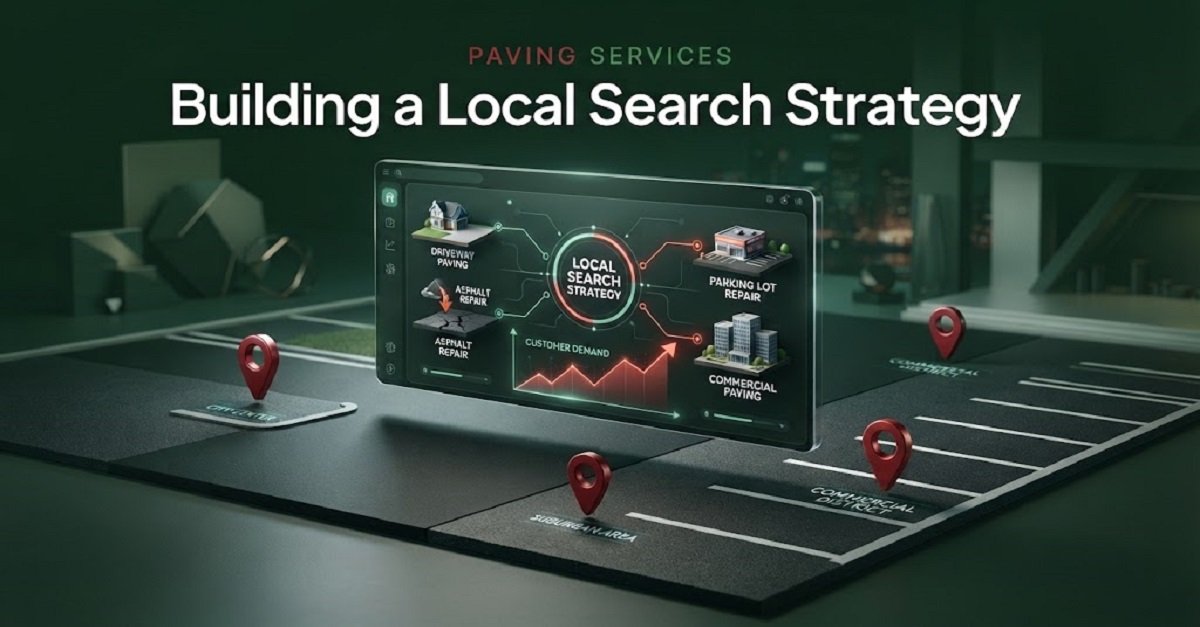
For example, a growing suburban area with new homes may offer stronger opportunities for driveway and new-construction paving. An older commercial district may have more demand for parking lot repairs and resurfacing.
The goal is not simply to find a large local service market. The goal is to find a market where the services you already perform have meaningful demand.
2. Analyze Local Search Behavior
Online search behavior can reveal what potential customers actually want.
Before entering a new local service market, examine the searches people make around paving services and related problems. Look beyond one broad keyword and consider different customer needs.
Someone may search for:
-
Paving contractor near me
-
Asphalt driveway contractor
-
Commercial paving company
-
Parking lot paving
-
Asphalt repair
-
Driveway replacement
-
Asphalt resurfacing
These searches can help identify both the size and the intent of the market.
This is also where local SEO becomes important. A paving contractor entering a new service area needs to understand whether the company's website and online presence can become visible for relevant searches in that location.
A contractor may have strong visibility in its current city but little organic visibility in a neighboring market. That difference matters before committing marketing resources to expansion.
3. Study the Competition Before Making a Move
A new market should never be evaluated without examining existing paving contractors.
Search for the services you want to offer in the target location and identify the companies already appearing prominently. Then study what they are doing well and where there may be gaps.
Look at factors such as:
-
Number of established competitors
-
Service areas
-
Types of paving projects shown
-
Customer reviews
-
Website quality
-
Project portfolios
-
Service pages
-
Local content
-
Online visibility
-
Response options
-
Contact information
You do not need to copy competitors. Their presence simply provides useful information about the market.
For example, if several companies have strong visibility for residential paving but very few appear focused on commercial parking lots, that may reveal a possible market gap.
Competition is not automatically a reason to avoid a market. It can actually confirm that customers are actively purchasing the service. The more useful question is whether your company has a realistic way to differentiate itself.
4. Identify the Most Valuable Customer Segments
Not every customer in a local service market has the same value.
A paving contractor should determine which customer groups are most attractive based on project size, profitability, service requirements, and repeat potential.
Possible segments include:
Homeowners
Residential customers may need driveway installation, replacement, repairs, or resurfacing. These projects can be easier to schedule but may have smaller average contract values.
Property Managers
Property managers can oversee multiple properties and may need ongoing asphalt maintenance. Building relationships with this segment could create repeat opportunities.
Commercial Property Owners
Shopping centers, offices, restaurants, warehouses, and other commercial properties may require larger paving projects.
Municipal or Institutional Properties
Schools, facilities, and other organizations may have larger projects but can involve different bidding, qualification, or procurement requirements.
Understanding these segments helps a contractor decide where marketing resources should be concentrated.
5. Compare Local Pricing and Project Economics
A market can have strong demand and still be a poor expansion choice if the economics do not work.
Before entering a new local service market, compare typical project pricing with your expected operating costs.
Consider:
-
Material costs
-
Labor costs
-
Equipment expenses
-
Fuel
-
Travel time
-
Disposal fees
-
Insurance requirements
-
Permits
-
Subcontractor costs
-
Project preparation
-
Potential rework
Distance deserves particular attention.
A project may appear profitable based on its contract value, but long travel times can increase fuel costs, equipment transportation expenses, and employee hours. If crews regularly spend significant time traveling between the existing service area and the new market, margins may suffer.
Market expansion should therefore be evaluated based on net profitability, not just potential revenue.
6. Examine Geographic Accessibility
A paving company cannot serve every location equally efficiently.
Map the proposed service area and consider how easily crews, trucks, rollers, pavers, and other equipment can reach the market.
A nearby market may be attractive because the company can use its existing workforce and equipment without creating a completely separate operation.
However, physical distance is only part of the equation. Traffic, major highways, seasonal conditions, road restrictions, and project scheduling can affect actual travel time.
A contractor should estimate realistic travel requirements before advertising aggressively in a new area.
7. Look for Market Gaps Instead of Fighting Everyone
One of the most useful parts of local service market analysis is identifying unmet needs.
Instead of asking only, “How many competitors are here?” ask:
“What are competitors not serving particularly well?”
For example, competitors may have generic service pages but little useful information about commercial paving. They may have many reviews but poor project documentation. They may target homeowners heavily while providing limited information for property managers.
Potential gaps can exist around:
-
Specific paving services
-
Commercial projects
-
Certain property types
-
Emergency repair
-
Maintenance services
-
Geographic neighborhoods
-
Customer education
-
Project transparency
A clear gap can give a contractor a more practical entry point than trying to compete across every possible service.
8. Review Local Online Visibility
Before entering a new market, examine how difficult it may be to establish online visibility.
Search the target location with relevant paving terms and observe the results.
Review:
-
Local organic results
-
Map visibility
-
Competitor websites
-
Service pages
-
Location-specific pages
-
Review profiles
-
Local directories
-
Industry listings
This research can show whether the market is dominated by a few highly established companies or whether there are opportunities for a new entrant to build visibility.
A local SEO strategy can support this process by improving the relevance and visibility of a paving company's website for searches connected to its actual service area.
The important point is to treat online visibility as part of the market-entry analysis, not as something to consider only after expansion.
9. Check Whether the Website Supports the New Market
A contractor may have a strong website for its current market but still lack the structure needed to support expansion.
Before targeting another city or service area, review whether the website clearly communicates:
-
What services the company provides
-
Where it operates
-
Which customers it serves
-
What types of projects it handles
-
Why customers should consider the company
-
How customers can request an estimate
Location relevance should be clear and useful rather than created through repetitive location keywords.
For example, a contractor expanding from one city into nearby communities may need genuinely useful location-specific information, project examples, and service details that help users understand whether the company can serve them.
This creates a stronger foundation for local SEO while also improving the experience for potential customers.
10. Analyze Reviews and Customer Expectations
Reviews can reveal what customers value most in a particular local service market.
Do not focus only on star ratings. Read the actual feedback.
Look for repeated comments about:
-
Communication
-
Scheduling
-
Work quality
-
Clean-up
-
Pricing
-
Professionalism
-
Project completion time
-
Reliability
-
Customer service
Negative reviews can also reveal opportunities.
If customers repeatedly complain that contractors do not communicate clearly, a new paving company could make communication a visible part of its customer experience.
If customers frequently mention delays, accurate scheduling may become another useful differentiator.
The objective is not to attack competitors. It is to understand customer expectations before entering the market.
11. Consider Seasonality
Paving demand can change throughout the year.
Weather, temperature, construction schedules, and local project cycles can affect when customers are most likely to purchase paving services.
A contractor should compare the target market's seasonal demand with its existing workload.
For example, expanding into a new area during a period when the current operation is already operating near capacity may create scheduling problems. On the other hand, a carefully planned expansion could help balance demand across different periods.
Seasonality should therefore be included in the financial and operational analysis rather than treated as an afterthought.
12. Measure the Cost of Winning a Customer
Revenue projections are useful, but customer acquisition costs are equally important.
Before entering a local service market, estimate how much it may cost to generate qualified leads.
Potential acquisition channels include:
-
Organic search
-
Local search visibility
-
Referrals
-
Paid advertising
-
Industry directories
-
Social media
-
Partnerships
-
Existing customer referrals
The contractor should compare the expected acquisition cost with the average value and profitability of a new customer.
A market that produces many low-value inquiries may be less attractive than a market producing fewer but larger and more profitable projects.
This is why market analysis should focus on qualified demand, not simply traffic or lead volume.
13. Test the Market Before Making a Major Investment
A contractor does not necessarily need to build a full operation immediately.
A smaller market test can provide useful information first.
For example, the company could begin by targeting a limited group of services within a specific geographic area. During the test period, track:
-
Search visibility
-
Website inquiries
-
Phone calls
-
Qualified leads
-
Estimate requests
-
Conversion rates
-
Average project value
-
Travel costs
-
Customer feedback
After collecting enough information, the contractor can determine whether the market deserves additional investment.
This approach reduces the risk of making a major expansion decision based entirely on assumptions.
14. Connect Market Analysis With a Practical Marketing Plan
Once the research is complete, the contractor should turn the findings into an actionable plan.
The plan should identify:
-
The target geographic area
-
The highest-value customer segments
-
The most relevant services
-
Major competitors
-
Market gaps
-
Expected customer acquisition costs
-
Operational requirements
-
Website and local SEO priorities
-
Lead-generation channels
-
Performance metrics
This creates a connection between market research and actual business growth.
Instead of saying, “We want more customers in this city,” the company can establish a specific strategy around which customers it wants, which services it will promote, and how it intends to reach them.
15. Know When the Market Is Not Ready
Good market analysis should also make it easier to recognize when expansion does not make sense yet.
A contractor may discover that:
-
Travel costs are too high
-
Demand is highly seasonal
-
Competitors dominate the most valuable searches
-
Project margins are too low
-
The company lacks sufficient crew capacity
-
Customer acquisition costs are too high
-
The target services do not match local demand
That does not necessarily mean the market should be abandoned permanently.
It may simply mean the company needs to adjust its service focus, improve its online visibility, strengthen operations, or test a smaller geographic area first.
Evaluating a Local Service Market Before Expansion
A paving contractor should evaluate a local service market from both a business and customer perspective before expanding into it. The analysis should consider local demand, competing paving companies, service pricing, customer expectations, travel costs, and online visibility. A local service market may look attractive because of population growth or construction activity, but the real opportunity depends on whether the contractor can consistently reach qualified customers and complete projects profitably. Reviewing these factors together can help a paving company identify a realistic market opportunity, choose the right services to promote, and build a stronger foundation for long-term growth
Final Thoughts
Entering a new local service market should be a research-driven business decision rather than a simple geographic expansion.
For paving contractors, the most useful analysis combines customer demand, search behavior, competition, pricing, operational costs, accessibility, customer expectations, seasonality, and online visibility.
Local SEO should be part of that evaluation because a contractor entering a new market needs to understand how potential customers discover paving companies online and how difficult it may be to establish visibility in the target area.
The strongest market opportunity is not necessarily the biggest city or the area with the most searches. It is the market where customer demand, project profitability, operational capacity, competitive conditions, and marketing opportunities can work together.
By analyzing these factors before expanding, a paving contractor can replace guesswork with evidence and make a more informed decision about where the next stage of growth should come from.