How Paving Contractors Can Build Trust Online Before a Customer Requests an Estimate
Paving contractors can do excellent work and still lose potential customers before the phone ever rings. In many cases, the problem is not the quality of the paving work itself. It is the lack of information, proof, and confidence a potential customer finds while researching the company online.
Before contacting paving contractors, homeowners, property managers, and commercial property owners often compare several companies. They look at websites, review project photos, read customer reviews, check services, and try to determine whether a contractor actually serves their area. They may also look for signs of experience before deciding whether requesting an estimate is worth their time.
That means a paving contractor's website has an important job to do before the estimate request.
It needs to answer the questions a customer is already asking.
Who is this company?
What paving services does it provide?
Has the contractor completed projects similar to mine?
Do previous customers appear satisfied?
Does the company serve my area?
What happens after I request an estimate?
For paving contractors, building trust online is not about making the biggest promises. It is about giving potential customers enough useful information and real evidence to make the next step feel comfortable.
Start With the Questions Customers Ask Before Calling
A common mistake among paving contractors is building a website around what the business wants to say instead of what customers actually want to know.
A contractor may be proud of its equipment, years of experience, crew, or workmanship. Those details can certainly matter. But a homeowner with a damaged driveway is usually thinking about a much more specific problem.
They may be asking whether the driveway needs a repair or complete replacement. A property manager may want to know whether the company handles parking lots. A commercial owner may want to understand whether the contractor has experience with larger projects.
The website should address those concerns naturally.
Instead of filling the homepage with general statements such as “Quality You Can Trust,” give visitors information they can actually use.
Explain the paving services you provide, the types of properties you work on, the areas you serve, and what customers can expect when they contact your company.
The goal is simple: reduce uncertainty before the customer has to make a decision.
When visitors can quickly understand the business and its capabilities, they have less reason to leave the website and continue searching.
Show Real Paving Projects Instead of Only Making Claims
One of the most effective ways for paving contractors to demonstrate credibility is to show their actual work.
A paving company can say that it has years of experience, but a potential customer may learn much more from seeing real completed projects.
Use genuine photographs whenever possible.
A useful project portfolio can include:
-
Residential driveway projects
-
Parking lot paving
-
Asphalt repair
-
Resurfacing projects
-
Commercial paving
-
Walkways and patios
-
Before-and-after conditions
-
Projects involving different surface problems
However, simply uploading a large collection of photographs is not enough.
Give important projects some context.
For example, instead of adding a photo with the caption “Completed Project,” explain what the customer needed, what type of paving work was performed, and what problem the project addressed.
A short project description might explain that an aging driveway had extensive surface deterioration and required preparation, repairs, and resurfacing.
This gives the visitor something meaningful to evaluate.
It also helps potential customers recognize situations that are similar to their own properties.
For paving contractors, real project evidence can often communicate experience more effectively than a page full of promotional language.
Make Every Major Paving Service Easy to Understand
A potential customer should not have to search through several pages to determine whether your company provides the service they need.
If your business offers multiple paving services, make the major ones easy to identify.
Depending on the company, these may include:
-
Driveway paving
-
Asphalt paving
-
Asphalt repair
-
Parking lot paving
-
Resurfacing
-
Sealcoating
-
Commercial paving
Each important service should provide enough information to help a customer understand what it involves.
Explain what the service is, what situations may require it, what factors can affect the project, and what customers should consider before requesting an estimate.
For example, an asphalt repair page should not simply say, “We provide professional asphalt repair.”
It could explain common signs of surface damage, why the underlying condition matters, and why the appropriate solution can vary from one property to another.
That type of information makes a paving website more useful and helps visitors understand that the company knows how to evaluate different project conditions.
Explain What Happens After an Estimate Request
“Request an Estimate” is an important call to action, but some customers hesitate because they do not know what happens after submitting the form or making the call.
Paving contractors can reduce that hesitation by explaining the basic process.
For example:
Step 1: Tell us about the project.
The customer provides basic information about the property and the paving work they are considering.
Step 2: Review the project requirements.
The contractor evaluates the relevant property conditions and project details.
Step 3: Discuss the recommended work.
The contractor explains what may be required and why.
Step 4: Review the estimate and next steps.
If the customer decides to proceed, the contractor explains scheduling, preparation, and other relevant details.
Every company will have its own process, so the website should describe the actual customer experience.
The purpose is not to create an impressive-looking process for marketing purposes.
It is to remove uncertainty.
When customers know what to expect, contacting a paving company feels less like taking a risk.
Put Genuine Customer Reviews Where Visitors Can See Them
Reviews can provide a type of information that a contractor's own marketing copy cannot.
A paving contractor can describe itself as reliable and professional, but a genuine customer can explain what it was actually like to work with the company.
For paving businesses, useful reviews may mention:
-
Communication
-
Scheduling
-
Workmanship
-
Professionalism
-
Responsiveness
-
Cleanup
-
Project completion
-
Overall customer experience
Make genuine customer feedback easy to find.
At the same time, avoid turning the website into a wall of unexplained five-star ratings.
Context makes reviews more useful.
For example, a review explaining that a crew communicated clearly, completed the work as expected, and left the property clean gives a potential customer something specific to consider.
Paving contractors should also respond professionally to customer reviews when appropriate.
The objective should not be to create the appearance of a perfect business.
The objective is to demonstrate that real customers interact with the company and that the business takes that feedback seriously.
Reviews can support trust, but they should work alongside other evidence rather than replace it.
Make Your Service Area Clear
Paving is a location-dependent business.
A homeowner does not simply need a contractor with good reviews. They need a contractor who actually works in the area where the property is located.
That is why paving contractors should make their service areas clear on their websites.
If your company serves multiple communities, identify those areas where appropriate. You can also explain the types of residential or commercial paving projects you commonly handle.
However, there is an important difference between providing useful location information and creating pages simply to target city names.
Avoid publishing dozens of nearly identical location pages where only the community name changes.
Instead, make location content genuinely useful.
A good service-area page can explain the services offered, the types of properties served, relevant project experience, and how customers in that area can get started.
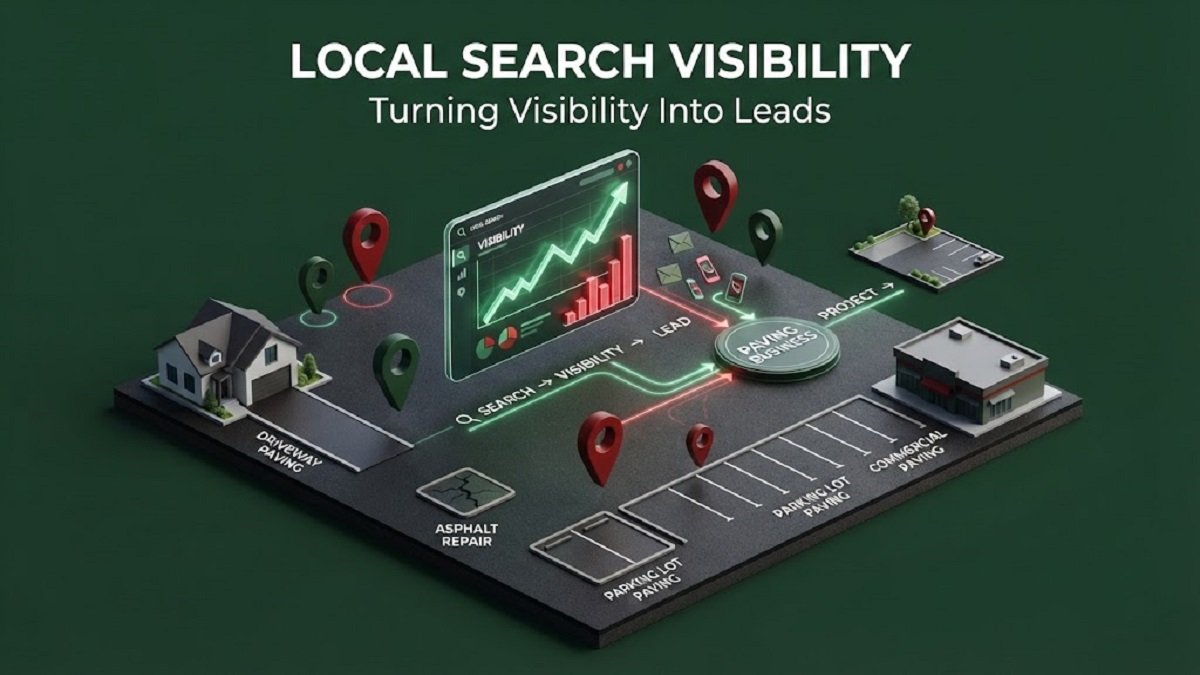
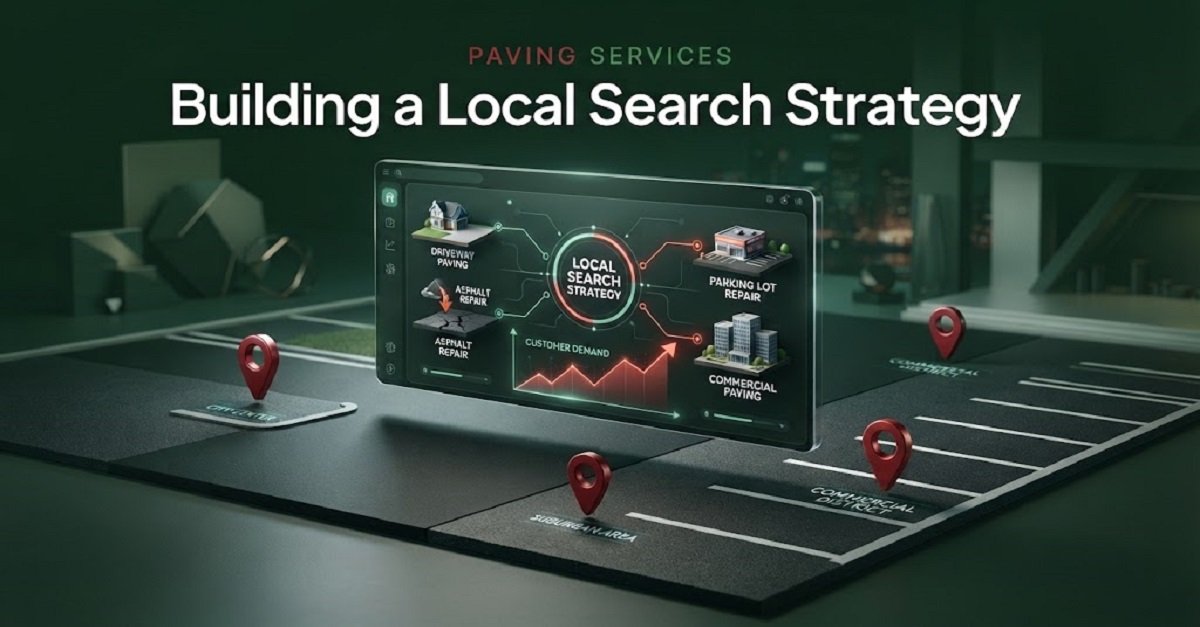
This is one area where local SEO can support the overall online presence of a paving business. Rather than repeatedly inserting location keywords, the goal is to create a consistent connection between the company, its services, its service areas, its website, and the information customers encounter when searching locally.
The customer should be able to understand both what you do and where you do it.
Keep Business Information Consistent Everywhere
Imagine a potential customer finds your paving company online and notices different phone numbers, conflicting service areas, or outdated business information.
Even if the company is legitimate, inconsistent details can create unnecessary doubt.
Paving contractors should regularly review the important business information displayed on their website and major online business profiles.
Check the following:
-
Business name
-
Phone number
-
Website
-
Address, where applicable
-
Service area
-
Business hours
-
Main services
-
Business description
This may sound basic, but basic information matters.
A customer should not have to wonder whether two online listings belong to the same paving company.
Consistency also makes it easier for people to verify the business before making contact.
Make Your Website and Google Business Presence Tell the Same Story
A paving contractor's website and Google Business Profile should feel like parts of the same business.
A potential customer may discover the company through Google Search or Maps and then visit the website. Another customer may find the website first and then search for the company's business profile to check reviews and other information.
Both experiences should be consistent.
Make sure the services listed online accurately represent what the company provides.
Make sure the contact information is current.
Make sure the service area is realistic.
Make sure the website clearly represents the same business customers find elsewhere online.
This consistency matters because visibility alone does not create trust.
A customer may discover a paving company, but discovery is only the beginning.
What they find after that discovery determines whether they continue researching or move toward contacting the business.
Help Customers Understand What Affects an Estimate
Many customers expect an estimate to be straightforward, but paving projects can involve different conditions from one property to another.
Project size, existing surface condition, preparation requirements, access, drainage, materials, and other site-specific factors can influence the work involved.
A useful website can explain those factors without pretending to provide an exact price before the property has been evaluated.
For example, two driveways may appear similar in size but require different preparation or repair work because their existing conditions are different.
Explaining this helps customers understand why a professional assessment may be necessary.
It also creates a better expectation around the estimate.
Instead of thinking, “Why can't they just give me a price from the website?” a customer can understand why the contractor needs more information.
That small amount of education can make the estimate process feel more professional.
Show the People and Experience Behind the Business
A professional website does not need to be complicated.
It needs to feel authentic.
Paving contractors can strengthen that sense of authenticity by showing the people behind the company, real equipment when relevant, actual project photographs, and information about the business's experience.
Useful trust elements may include:
-
Company history
-
Team information
-
Real project photos
-
Customer reviews
-
Relevant certifications
-
Licenses or credentials, when applicable
-
Insurance information, when appropriate
-
Industry memberships
-
Accurate awards or recognition
Only display credentials and claims that are legitimate and current.
A long list of impressive-sounding statements does not necessarily build trust.
Specific evidence is usually more useful.
A potential customer wants to know that there is a real paving company behind the website and that the company has experience handling projects like theirs.
Create Helpful Content Around Real Paving Problems
A paving website does not have to be limited to service pages.
Helpful educational content can answer questions customers often have before hiring a contractor.
For example:
-
How can you tell whether asphalt needs repair or replacement?
-
What factors can affect the cost of a paving project?
-
What should property owners do before paving begins?
-
How should a newly paved surface be maintained?
-
What can contribute to premature asphalt deterioration?
-
What should commercial property owners consider before repaving?
These questions can become blog posts, FAQ sections, service-page resources, or project guides.
The important part is to provide practical information rather than creating content simply to fill the website.
When a paving contractor consistently answers useful questions, the website becomes more than a digital business card.
It becomes a resource that helps potential customers understand their options.
That can be particularly valuable for people who are still researching and are not ready to request an estimate yet.
Review Your Website Like a Potential Customer
One of the simplest ways for paving contractors to identify trust problems is to stop looking at the website like the business owner.
Look at it like someone who has never heard of the company.
Ask yourself:
Can I understand the main paving services within a few seconds?
Can I tell where this company works?
Can I see real examples of completed paving projects?
Can I find genuine customer reviews?
Can I understand what happens after I request an estimate?
Can I easily find a phone number or contact form?
Can I understand what makes this company relevant to my project?
Does the website look current and trustworthy?
If several answers are no, the problem may not be a lack of traffic.
The website itself may be creating friction.
That is an important distinction.
There is little value in continually trying to bring more visitors to a website if those visitors arrive and cannot find the information they need to make a decision.
Build Trust Before Asking for the Sale
Paving contractors often focus heavily on getting the phone to ring or getting more estimate requests.
Those goals matter, but the process starts earlier.
Before a customer calls, they may spend several minutes or even several days researching different paving companies.
During that research period, your website has an opportunity to answer questions and provide evidence.
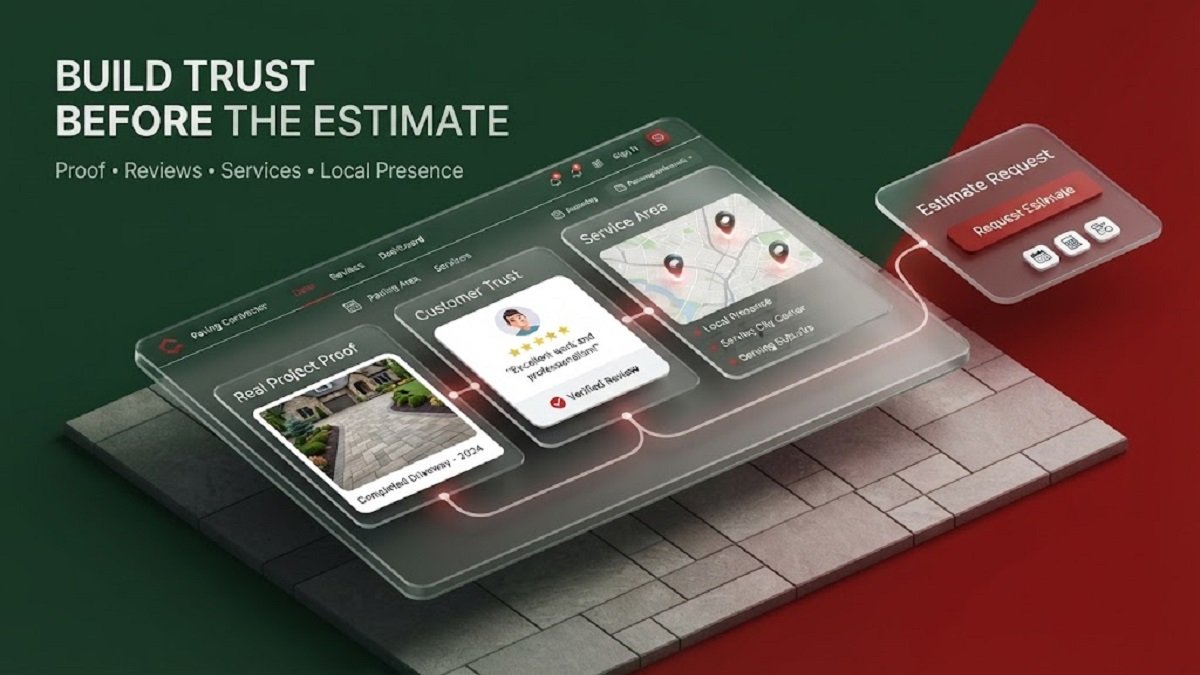
Real project photos can demonstrate experience.
Service pages can explain what you do.
Reviews can provide customer perspective.
Service-area information can clarify whether you are relevant to the visitor.
Educational content can answer questions.
Clear contact information can make the next step easy.
Together, these elements create a much stronger online experience than a website built around a few large claims and a “Get a Free Quote” button.
Trust Is an Online Asset for Paving Contractors
A customer does not suddenly begin trusting a paving contractor after clicking an estimate button.
Trust is usually built during the research that happens before that click.
For paving contractors, the goal should be to make that research easier and more informative.
Show the work.
Explain the services.
Answer realistic questions.
Present genuine customer feedback.
Make the service area clear.
Keep business information accurate.
Explain the estimate process.
Make it easy for customers to contact you when they are ready.
And make sure your website reflects the quality and professionalism of the actual business.
A strong online presence does not need to make extraordinary promises. It needs to give potential customers enough reliable information to understand who you are, what you do, where you work, and what they can expect.
Before investing more in bringing people to your website, take a close look at what those people experience once they arrive.
If a potential customer can quickly find evidence of your experience, understand your paving services, verify your business, and feel comfortable taking the next step, your website is doing more than generating visibility.
It is helping turn online research into genuine customer confidence—and eventually, into an estimate request.
For a paving business, that trust can become one of the most valuable parts of its online presence.