When Local Competition Changes Mid-Campaign: Strategic Recalibration Without Losing Search Equity
A local SEO campaign rarely operates in a static market. Local competition changes as new businesses enter the market, established competitors strengthen their digital presence, and customer search behavior evolves. Understanding how local competition changes helps businesses adjust their strategy without unnecessarily disrupting the progress they have already made.
A campaign that worked well several months ago may face a very different environment today. New competitors may target the same services, existing businesses may improve their websites, and customers may begin using different search terms.
That is why monitoring local competition changes should be part of an ongoing SEO process rather than a one-time research task.
Why Local Competition Changes During a Campaign
There are several reasons local competition changes over time.
A new company may enter the market with an aggressive digital strategy. An established competitor may invest in content, improve its website structure, strengthen its business profile, or expand its service coverage.
Customer behavior can also influence local competition changes.
Searchers may start using more specific phrases, looking for different services, or searching from new geographic areas. As demand shifts, businesses may change their own marketing strategies to capture those opportunities.
This means the competitive environment is constantly developing.
A successful campaign needs to recognize these changes without reacting to every small movement in the search results.
Why Mid-Campaign Adjustments Need Care
When local competition changes, the natural reaction may be to change everything.
That can create unnecessary problems.
SEO assets take time to develop. A page may have accumulated useful content, internal links, relevant references, and search visibility over several months. Replacing that page simply because a competitor has become stronger can remove valuable equity.
The same applies to keyword targeting.
A campaign should not abandon an established topic every time local competition changes. Instead, the team should determine whether the existing page can be improved, expanded, or better aligned with current search intent.
The goal is controlled adaptation.
Identify Where the Competitive Gap Has Appeared
The first step after noticing local competition changes is identifying exactly where the pressure exists.
A competitor may be stronger for broad service searches but weaker for specific customer problems. Another business may dominate one geographic area while having limited visibility in another.
Businesses using local SEO should compare competitor visibility acrosss locations, seervices , and search intent rather than looking at rankings alone.
This creates important opportunities.
Instead of asking which competitor is winning overall, examine where their visibility has increased and where gaps still exist.
Look at:
-
Search queries
-
Ranking patterns
-
Competitor landing pages
-
Service coverage
-
Geographic visibility
-
Content depth
-
Search intent
-
Organic traffic trends
This helps turn local competition changes into useful market intelligence.
Protect Existing Search Equity
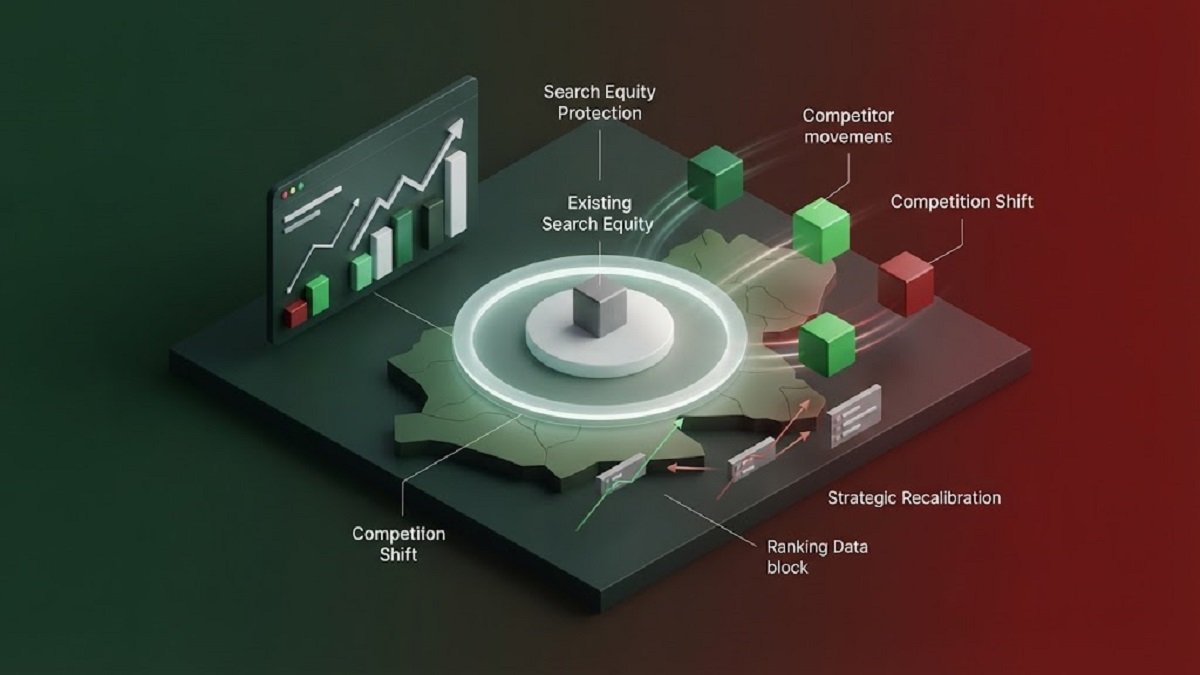
One of the most important considerations when local competition changes is protecting the value already created.
Search equity can develop through established content, internal linking, relevant external references, topical relevance, useful landing pages, and accumulated user engagement.
These assets should not be discarded simply because the competitive landscape has shifted.
An established service page may need better information rather than replacement. An older article may need updated examples. A page that has lost visibility may benefit from stronger internal links and clearer search intent alignment.
When local competition changes, improving existing assets can often be more efficient than constantly creating new ones.
Look Beyond Competitor Keyword Lists
Keyword research is useful, but it should not become the entire response to local competition changes.
Copying a competitor's keyword list rarely creates a strong long-term strategy.
Search intent provides more useful context.
Customers may begin with a broad service search and later use more specific queries related to problems, locations, pricing, urgency, or service characteristics.
A competitor may rank for a broad phrase while missing several high-intent searches.
Understanding these gaps allows a business to create content based on actual customer needs rather than simply copying competitor terminology.
Reevaluate Geographic Opportunities
Geographic shifts are another important part of local competition changes.
A business may have operated in a relatively open market for years before another provider expands into nearby neighborhoods or service areas.
That does not mean every location requires a new landing page.
Geographic content should reflect genuine business relevance. If a company truly serves a particular area, useful information can help visitors understand available services and local expertise.
Creating large numbers of nearly identical location pages simply because local competition changes can weaken content quality.
The focus should remain on useful geographic coverage rather than page volume.
Create Content Competitors Cannot Easily Copy
When local competition changes, publishing more content can seem like the obvious solution.
More content, however, does not automatically create more competitive strength.
Generic articles can be copied easily. What is harder to reproduce is genuine expertise, original research, customer insights, practical examples, industry experience, and unique business knowledge.
This is where a strong content strategy can respond effectively to local competition changes.
Instead of creating another generic article on the same topic, businesses can answer questions based on real customer experiences and provide information competitors may not have.
That creates stronger differentiation.
Review Internal Linking
Internal linking can become increasingly important when local competition changes.
Some pages may become more commercially important. Others may need stronger contextual support.
Review how service pages, educational articles, location pages, and supporting resources connect.
A useful article can guide visitors toward a relevant service page. A service page can connect users with supporting information. A location page can connect visitors with services genuinely available in that area.
This creates a logical website structure.
It also allows a business to strengthen important pages without creating unnecessary content simply because local competition changes.
Do Not React to Every Ranking Movement
Search rankings naturally fluctuate.
When local competition changes, one competitor appearing above your page for a short period does not automatically mean the strategy needs to be rebuilt.
Look for sustained patterns.
Has the competitor gained visibility across several related searches? Are multiple competitors becoming stronger? Has organic traffic declined consistently? Are qualified leads being affected?
These questions provide more useful information than reacting to one ranking position.
A measured response is especially important when local competition changes quickly.
Use Performance Data Before Making Adjustments
Data can help determine whether local competition changes are actually affecting business performance.
Review:
-
Organic impressions
-
Click-through rates
-
Landing-page traffic
-
Qualified leads
-
Conversion activity
-
Search query trends
-
Geographic performance
-
Page-level visibility
-
Competitor movements
These metrics should be evaluated together.
For example, increased impressions with declining conversions may indicate that visibility is not the main problem. Search intent, landing-page messaging, the offer, or the user experience may require attention.
This prevents businesses from blaming every performance change on local competition changes.
Keep the Core Strategy Stable
A campaign does not need to be rebuilt every time local competition changes.
The core strategy can remain stable while specific areas receive additional attention.
That might include updating important service pages, improving older content, strengthening internal links, expanding relevant geographic information, or developing resources around emerging customer needs.
This approach protects the campaign's foundation while allowing it to evolve.
Think of it as steering rather than restarting.
Build Around Customer Demand
Competitors can reveal useful information about the market, but they should not control the entire strategy.
When local competition changes, businesses should also look at their own customers.
What questions do customers ask before contacting the company? Which services generate the most interest? What concerns prevent people from taking action? Which useful topics are missing from the website?
These questions can reveal opportunities that competitor analysis alone cannot provide.
A customer-focused strategy remains useful even when local competition changes again in the future.
Recalibration Should Be Continuous
The best response to local competition changes is usually controlled recalibration rather than a complete reset.
Review the data. Identify areas of pressure. Protect valuable pages. Improve weaker sections. Expand where genuine demand exists. Remove unnecessary duplication.
This creates a disciplined process.
Instead of making dramatic changes whenever rankings move, the campaign evolves through measured improvements.
That makes it easier to respond when local competition changes again.
Build a Strategy That Can Absorb Change
No local search market remains unchanged forever.
New businesses will enter. Existing competitors will improve. Services will evolve. Customer expectations will shift.
A resilient campaign is designed around this reality.
It does not depend entirely on one keyword, one page, or one competitor analysis. Instead, it builds a connected digital presence supported by useful content, relevant geographic information, strong internal relationships, and a clear understanding of customer intent.
That makes future local competition changes easier to manage.
Local competition changes are a normal part of long-term SEO.
They do not automatically mean that an existing campaign has failed or needs to be completely rebuilt. The more sustainable approach is to understand what has changed, protect valuable search equity, and make focused improvements where competitive pressure has increased.
Businesses should look beyond rankings and consider search intent, content quality, geographic relevance, internal linking, customer behavior, and business performance.
The goal is not to react to every competitor movement.
The goal is to build a strategy that can adapt intelligently when local competition changes while preserving the value created through previous SEO work.
Frequently Asked Questions
1. What does local competition changes mean in an SEO campaign?
Local competition changes means the competitive environment around a business has shifted. New competitors may enter the market, existing businesses may improve their digital presence, or customer search behavior may create new areas of competition.
2. Should an SEO campaign change when local competition changes?
Yes, but not necessarily through a complete reset. When local competition changes, businesses can review performance, identify competitive gaps, and make targeted improvements while protecting existing search equity.
3. How can businesses monitor local competition changes?
Businesses can monitor search results, competitor visibility, search queries, landing-page performance, geographic trends, content updates, and changes in competitor services. Consistent monitoring makes local competition changes easier to identify.
4. Can local competition changes reduce existing search visibility?
They can contribute to changes in visibility, but ranking movement has multiple possible causes. When local competition changes, businesses should compare competitor activity with their own technical, content, geographic, and performance data before making major decisions.
5. How often should businesses respond to local competition changes?
There is no universal schedule. Businesses should monitor their market regularly and respond when meaningful patterns appear. A measured response to local competition changes is generally more useful than making frequent changes based on isolated ranking movements.